Concrete impregnation - guide to concrete sealer
Everything you need to know about concrete sealer (concrete impregnation)
A concrete sealer, or concrete impregnation, makes concrete surfaces water and dirt repellent, increases durability and makes the surface easier to keep clean. Below we answer common questions — from drying time and application to the difference between clear and colored sealer products.
1. Fast drying concrete sealer – does an impregnation dry quickly?
There are two main types of sealers: film-forming (e.g. acrylic or epoxy) and penetrating impregnations. Penetrating, water-based impregnations tend to dry relatively quickly on the surface because they penetrate the pores of the concrete and do not lie as a film on the surface. Typical drying times are:
- Surface dryness: often within 1–3 hours depending on temperature and humidity.
- Can be easily loaded: usually after 12–24 hours.
- Full cure/maximum performance: up to 48–72 hours.
Please note that lower temperatures and high humidity will extend the drying time. For industrial floors where rapid restoration of traffic is required, special “same day” film-forming products are available, but they build a surface that may require more preparation.

2. What is meant by "sv21 premium same day concrete sealer" compared to impregnation?
The term "same day" often refers to products that create a surface quickly enough to open to traffic the same day. These are often film-forming and create a surface film that dries quickly. Differences:
- Same day / film formation: fast surface drying, visible finish, may change gloss/appearance, often requires thorough cleaning and priming in some cases.
- Penetrating impregnation (like many water-based sealers): penetrates, does not change the appearance to the same extent, provides permanent water and dirt repellency and increased wear resistance without a visible film.
For industrial floors where durability, slip resistance and dust sealing are a priority, many prefer a penetrating impregnation. Make sure the product specifications are clear if quick opening to traffic is essential.
3. Coloured concrete sealer (e.g. from retailers like Bunnings) – when do you choose coloured sealer?
Colored sealers are used when you want to change or improve the appearance of concrete — for example, for driveways, patios or retail spaces where aesthetics play a big role. Differences to consider:
- Colored sealers are often film-forming or contain pigments; they cover and change the appearance.
- Penetrating impregnations are usually transparent and preserve the natural appearance of the concrete.
- Colored products may require more maintenance cycles (if the film is scratched or torn), while impregnation provides a more maintenance-free, deep-acting treatment.
4. Concrete sealer – how do you apply an impregnation?
The following steps are a general, practical workflow for water-based concrete impregnation:
- Clean the surface thoroughly: remove oil, grease, dust and loose particles. High pressure washing or mechanical brushing may be necessary.
- Repair larger cracks and irregularities before treatment.
- Ensure that the concrete is dry enough for application and that the temperature and humidity are within recommended ranges.
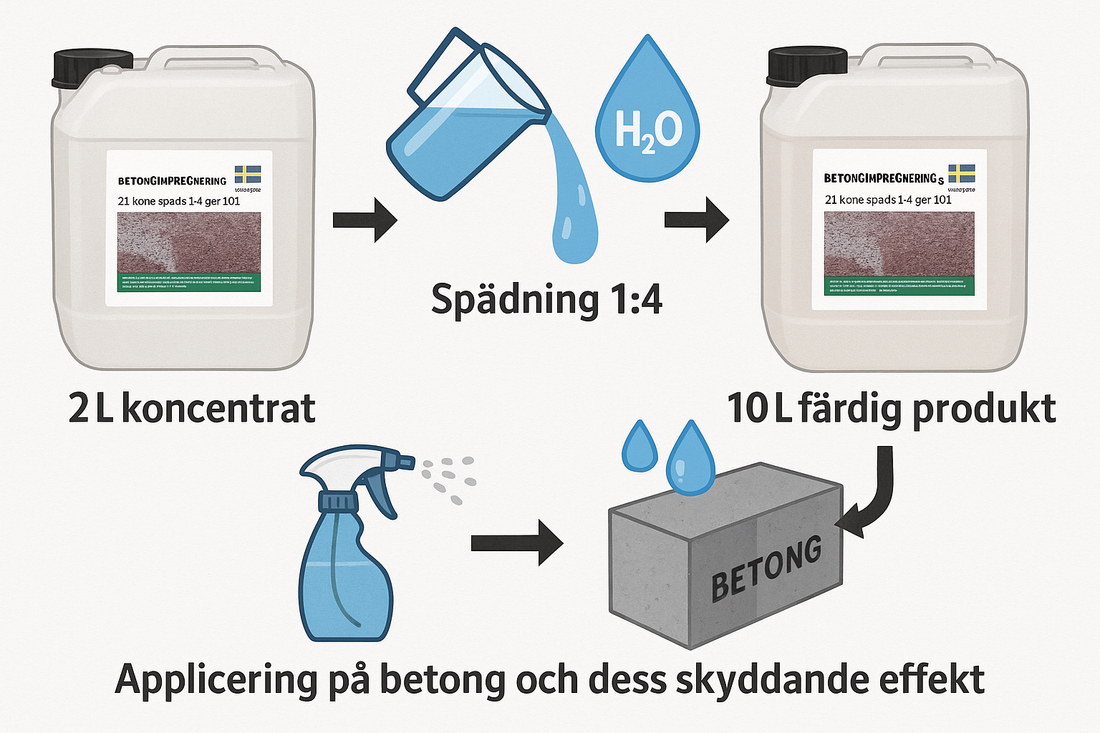
- Mix the concentrate according to instructions (e.g. 1:4 with water when the product is concentrated) if the product is a concentrate variant.
- Apply evenly with a low-pressure sprayer, roller or lambswool mop. For penetrating impregnation, one even, flowing coat is usually sufficient; on very porous surfaces, several coats may be required until the surface no longer absorbs.
- Dry and ventilate the area. Avoid walking on the surface until it has sufficiently cured according to the product instructions.


Tip: Use personal protective equipment, work in sections and always test on a smaller area first.
5. Concrete sealer clear – will the impregnation be completely invisible?
Penetrating water-based impregnations are usually transparent and do not change the color of the concrete to a significant extent. They do not form a visible film but penetrate the material to repel water and dirt and increase wear resistance. If you are looking for a result that preserves the natural appearance of the concrete, a clear impregnation is usually preferable.
Practical recommendation
For warehouses, production halls, garages and other industrial environments where durability, dustproofing and easy cleaning are a priority, a water-based, penetrating impregnation is often the best choice. An example of such a product that is concentrated (1:4) and provides good water and dirt repellency when diluted with water is
.
Final advice
Choose the product type according to your needs: if you want fast opening for traffic and an aesthetic finish, film-forming quick sealers may be suitable. For durable, low-maintenance concrete protection and preserved appearance, penetrating impregnation is recommended. Always read the product sheet for exact mixing ratios, application method and safety precautions.